Tuesday, October 7, 2008

November Program

Tony & Carolyn Green, Owners
Bay Hill Marina
and
Captain's Table Restaurant

The Bay Hill Conservancy is proud to announce the autumn program. Tony and Carolyn Green, the new owners of Bay Hill Marina and the Captain's Table Restaurant will give a presentation to the Bay Hill Conservancy. The entire neighborhood, including the Ledges, boat owners and the media are invited. Come on down and bring a friend!

Sunday, November 2, 2008
2:00pm
Marina meeting room (next to marina pool)

Tony and Carolyn will tell us how they discovered Bay Hill Marina, where they hail from and what their plans are for the marina's future. Please join us in welcoming the Greens to our beautiful Village.

Snacks provided by Captain's Table Restaurant

Bottled water will be provided.

For more information, contact:

Carroll Adams or Debi Bradford

Wednesday, September 10, 2008

Autumn's Coming to Bay Hill Village

Members of the Bay Hill Conservancy and Bay Hill Village overall have enjoyed a lovely summer of vacations and staycations, and many are looking forward to the autumnal bliss filled with color and that special "fall light."

Carroll and Debi are planning a Very Special Program for October - date TBA. Watch your e-mails and this blog for details. In the meantime, enjoy excerpts from an article Debi found in the August-September 2006 issue of Cabin Life Magazine.

Loving Your Lake
10 Tips for keeping your water clean and healthy - forever
By Steve McComas

"How can you ensure that the lake you love remains beautiful and healthy for generations to come? You can show your love for your lake by incorporating these 10 tips into your lake life.

1. Buff up the buffer: A lakeside buffer is a growth of unmowed native vegetation from the shoreline extending to upland areas. Grass mowed down to the edge of the water is not a true buffer. Although it provides groundcover, it is not effective for filtering pollutants in runoff water, and it's poor wildlife habitat.

2. Let a fallen tree lie: Shallow water near the shores of lakes are vital nurseries for all fish species as well as a variety of birds and animals. Practically all fish species rely on nearshore habitat at some point in their life cycle. Deadfall - such as a fallen tree in the water - provides great habitat

3. Control exotics: If exotic species are present in your lake, they will be nearly impossible to eradicate. Is there a prevention program in your lake? Does your lake association mail out information on spotting and controlling exotics plants such as Eurasian watermilfoil?

4. Minimize mowed lawns: Rainwater and snowmelt runoff can deliver clean and pure water to a lake - and that's a good thing - or it can deliver fertilizer components and sediments - and those are bad things. Mimic Mother Nature's work if you can.

5. Avoid fertilizing: A native groundcover should thrive without fertilizer. However, if you do use fertilizer consider using phosphorus-free varieties.

6. Balance plants and algae: A battle is always raging in lakes between plants and algae. When plants win, the result is usually clear lake water. You can help the plants win.

7. Maintain that septic system: A malfunctioning septic tank system can contaminate nearby drinking water wells and deliver unwanted materials to the lake.

8. Catch and release: Why is fishing fun? One of the reasons is fish taste good. Releasing most large fish back to the lake helps maintain balance through the fish community.

9. Keep things in check: Sometimes just a simple visual checkup can help point you in the right direction. Example - check the runoff patterns on your lot (is it eroding, is there sheet flow, any problems?), check water running off roofs and gutters, check detergents and use non-phosphorous detergents if possible; properly store hazardous chemicals.

10. Monitor the lake health: Several benchmark tests can be used to gauge lake status and some things can be monitored just for fun. Daily journals of wildlife observations and lake phenomena can be handy references.

So keep a journal, let your shoreline grow au natural, release the lunkers and fertilize your garden with leftover bait minnows. All these activities can make your lake a little bit better. And if you and our neighbors all take care of your lake, it can be enjoyed by many, many generations to come."

To read the complete article click on this link: "Loving Your Lake"

Sunday, June 8, 2008

Spirit Award to Villas II

Most mornings find me walking my faithful companion, Baylee, our "Berniel." (Bernese Mountain Dog meets Spaniel) We usually walk to the marina and back, with occasional side trips to the barges to sit and watch the sun rise over the eastern shore before returning home.

Baylee is always on alert for the odd dove or dog or cat or killdeer, which amuses her to no end, as does smelling each blade of grass and every shrub. For myself, I enjoy the scenery. This spring I've been delighted each morning walking the sidewalk past Villas II, and have made their houses a must for my morning "House & Garden Tour."

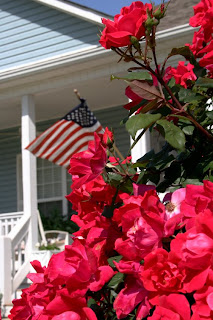
Villas II epitomizes all that each of us desire in a neighborhood. These neighbors have banded together and agreed to form a corridor filled with flowers and American flags. This work in progress has been a joy to watch. Our generous spring rains coaxed early blooms in abundance across the street from my house. Each house has also decorated with fun lakeside adornments that make me smile with each passing.

I sent them a note in May and asked if I could take photos of their yards to post them on our Conservancy blog. This isn't necessarily Bay Hill Conservancy educational material, granted. However, Carroll and I both feel compelled to recognize Villas II as an area that is working together to create the kind of beauty and camaraderie we all wish to see throughout this neighborhood. "It Takes A Village" is an over-used phrase, but most certainly it applies here at Bay Hill. Please take a moment to drive or stroll past Villas II and soak up the beauty that they have created. As far as the Conservancy, we just wish to recognize their efforts and give them a Virtual Spirit Award. Congratulations, Villas II!

Please enjoy these photos of the gardens and houses of those who agreed to be photographed:


Betty Harrison's villa


Wayne & Deb Bullard's villa


Brad and Tricia Bratcher's villa


Bob & Mary Radant's villa


Betty Benson's villa


There are other villas within villas II that were not recognized because permission wasn't given. My thanks to Villas II residents who allowed me to share their houses and yards with us all. Well done!

Wednesday, May 28, 2008

Weird, Obnoxious Swarming Things


Yesterday's rains were liquid gold to the farmers, added several inches to our depleted water table, and brought that special God-given green to our lawns and plants. It also caused various birds and creatures to seek shelter during the all-day downpour. Unfortunately, some of us at Bay Hill attracted millions and millions and millions of what I've been calling those Weird, Obnoxious Swarming Things to our porches and doorways, and plastered upon our houses. They reminded me of Maylies the way they hummed overhead and lifted up in frenzied angst when you walked by them. See the photo above? They were that thick all over my porch and house. Ick.

They don't bite, they don't eat foliage or fruits, but they do emit a black, tarry goo that's close to impossible to remove. What ARE these things? Where did they COME from?!

Ah, I know. I'll ask Damien Simbeck, our TVA Wildlife Biologist and Friend of Bay Hill.

A section of the ceiling of our front porch. It was like this everywhere.

A close up of a male Weird, Obnoxious Swarming Thing, and some of the tarry, black goo. Males have a slighter body with antennae. Females are heavier, darker, with no antennae. I know this because of their lustful advances that occurred on the window of my front door. Ahem.
Damien answered my e-mail quickly, and Carroll and I wanted you all to know what these creatures are.
In Damien's own words: "Appears to be one of the many Chironomids (midges) found in this area. This group is VERY diverse, and VERY common. The larvae are very tolerant of variable water quality conditions, so they are typically found everywhere. Although they do have population fluctuations, they are usually common every summer around the area (any where near water, that is). Like you said, they do not bite (or even feed as adults). They merely live a day or two, reproduce, then die. The entire population will probably emerge, reproduce and die within a few weeks, then they will be gone until next year (of course, other species have the same cycle, and they may emerge at different times of the year).

I have not seen a decrease in mayfly populations along the area reservoirs. May be a local decline (movement of populations, changes in reservoir substrate, etc.) that you are noticing at Bay Hill. The same cause(s) may explain the recent increase in midge populations."
Note: I had asked him about the decrease in Mayfly populations, but apparently that's just happening here.
So now we all know that these Weird, Obnoxious Swarming Things are - Midges.

Thursday, April 24, 2008

New Entrance Signs!

East Side Entrance Sign
You've no doubt noticed the new entrance signs at the corner of Bay Hill Avenue and Snake Road. These are high-quality signs, made with stone and wrought iron with a cast metal sign. As well, you may have noticed the iron and stone work at the "T" of Bay Hill Avenue and Bay Village Drive. The new entrance signs are finished, but the contractor made an error on the directional sign so it is being re-worked and is due to be installed soon.

West Side Entrance Sign

We now have appropriate signage to let family and visitors know that they've come to the right place, and it's taken a Village to accomplish this. The Bay Hill Sign Committee thanks each and every one of you who contributed personal funds so that our Village can be appropriately marked for not only friends and family, but delivery services, fire trucks, ambulances, school buses, horse-back riders, bicyclists, UFOs, or whatever and whoever needs to find us.

Direction Sign at the "T"

Oh, I know what you're thinking. Yeah, the signs are great....but the land around them looks terrible! The signs are low to the ground and there is a lot of stuff behind them competing for attention. The marina clearly overshadows the east-side sign, and the west-side sign has that house behind it. The west-side sign has other problems as well, like a row of old boxwoods between it and the street, and a light pole. Clearly, obviously, and without a doubt more work has to be done.

You will be pleased to know that several landscaping plans have been visited, and even more may be proposed. BUT NOTE - any landscaping for that area must and will wait until autumn. Why? This summer the drought is expected to continue, and that could be the death knell for any new plants put in those particular areas. Again, why? New plants required LOTS of water and attention in order to become established. The Bay Hill Conservancy has recommended the use of native plants which, when established, will require lots less maintenance. However, they must be established just like any other plant. Water is key, and the water issue will be worked out before autumn. Autumn, winter and spring rains, if we get them, are critical. Regardless, even through winter, watering has to be monitored even if we half to schlep gallon jugs of H20 in the back of our cars or golf carts and hand water each plant.

So, keep your eyes on the prize - next spring they will be Fabulous!

Sunday, April 20, 2008

Patty Kimm Gallery #2 - Casper and the Mallards


Larry & Patty's cat, Casper, would like to befriend the Mallards


The Mallards snub Casper and head into the bay

There are apparently lots of tasty snacks for the Mallards here.

This appears to be Mallard nirvana
One of Bay Hill Conservancy's missions is to provide education about our our flora and fauna. Since Patty has generously shared her Mallard pictures, the least I can do is offer some Mallard Facts. You can check out the Cornell Lab of Ornithology Mallard page by clicking the link provided and learn even more, but here are some "Cool Facts" Cornell offers:
"The Mallard is the ancestor of nearly all domestic duck breeds (everything except the Muscovy Duck). Many of the domestic breeds look like the wild birds, but usually are larger. They are variable in plumage, often lacking the white neck ring or having white on the chest. Feral domestic ducks breed with wild Mallards and produce a variety of forms that often show up with wild ducks, especially in city parks.
Mallard pairs are generally monogamous, but paired males actively pursue forced extra-pair copulations. Copulation between members of a pair usually takes place in the water after a long bout of elaborate displays. Forced copulations are not preceded by displays, and several males may chase a single female and mate with her.

Mallard pairs form long before the spring breeding season. Pairing takes place in the fall, but courtship can be seen all winter. Only the female incubates the eggs and takes care of the ducklings."
Hm.
BTW, I can't explain why Blogger messes up my paragraph spacing. It just does sometimes.

Friday, April 18, 2008

Patty Kimm Gallery #1


The Bay Hill Conservancy is fortunate to have such talented photographes in our ranks. Patty Kimm has shared some outstanding photos from her "catbird seat" in Phase 1. Each of us have experienced glorious sights on this river system never before seen. Sunsets can be a vivid museum-quality Dutch oil painting. Sunrises have upon occasion been so crimson that for all I knew the sky was bleeding.


Storms never fail to impress us with the havoc they play on the water's surface. Just last week there were 6 foot swells washing over our decks.


Who can forget the tornado that plowed through the marina, and hurricane's Katrina and Rita? I cannot imagine the fury of those hurricanes further south, as here it was quite frightening. Thank you for sharing your photos with us, Patty. Her next set of photos will be posted soon.